• 42 min
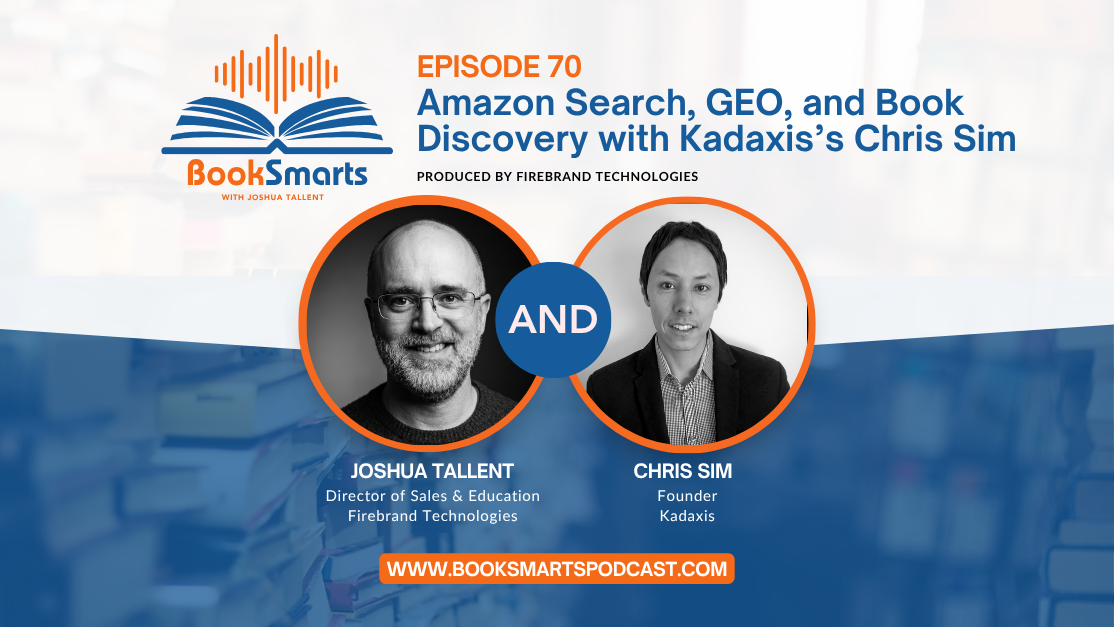
Episode 70: Amazon Search, GEO, and Book Discovery with Kadaxis’s Chris Sim
BookSmarts Podcast
Play
Chris Sim is the founder of Kadaxis, which uses AI and market signals to help publishers understand what readers are looking for and make their books more discoverable in retail search and in AI tools like ChatGPT. The company runs keyword and metadata programs at catalogue scale, with methods refined across hundreds of thousands of titles, and publishes original research on Amazon search and generative engine optimization (GEO). Its clients include several of the largest trade houses. Kadaxis was named BookTech Company of the Year at the FutureBook Awards and shortlisted for a BISG Industry Innovation Award. Chris was previously CTO at Bookish.com, the book discovery venture backed by Penguin, Hachette and Simon & Schuster, where he built its search and recommendation systems and co-authored a patent for a literary recommendation engine. He was later a venture CTO at BCG X, formerly BCG Digital Ventures, where he was recognized as one of the firm's global topic leaders in generative AI. He has spoken at industry conferences, published in industry journals, and contributed to BISG's keywords best-practices standard.
On this episode of the BookSmarts Podcast, Chris joins Joshua Tallent to discuss how publishers can optimize their book discovery strategies for both traditional search engines and AI-driven tools.
Drawing from Kadaxis’s empirical research on Amazon Search and Generative Engine Optimization (GEO), Chris breaks down why over 90% of standard publisher keywords fail to drive exact-match search visibility and explains why natural, search-phrase-based keywords dramatically outperform single-word "tagging." He reveals how Amazon’s "warm start" algorithms leverage book descriptions, cover images, and descriptive metadata to establish comp relationships for new titles before sales data exists, and outlines actionable steps publishers can take to ensure their books are indexed, recommended, and cited as authoritative sources by large language models like ChatGPT.
Resources Referenced:
https://kadaxis.com/notes/how-books-show-up-in-chatgpt-and-ai-search
https://kadaxis.com/notes/should-book-keywords-be-single-words-or-search-phrases
Digital Transcript
Hello and welcome to the Booksmarts podcast, where we talk about publishing data and technologies, and send you away with some insights that will help you sell more books. I'm your host, Joshua Tallent. So this month on the Booksmarts podcast, I'm talking to an old friend, Chris Sim from Kadaxis. Chris and I, man, we've known each other for a long time. Used to do some work together between Kadaxis and Firebrand, probably about eight years ago or so. But Kadaxis is a company that specializes in book discoverability, and Chris is one of the leading experts in book publishing on keywords and GEO and these kinds of topics. So obviously, somebody we want to have on the podcast. Chris, thanks for joining me.
Chris Sim
Thank you, Joshua. Great to be here, and yeah, I'm really glad to be doing this collaboration with you after so long.
Joshua Tallent
Yeah, you have a long background in publishing. You were the CTO at Bookish back in the day, and worked on some AI tools there for book discoverability. So, and then Kadaxis obviously was well known for keywords as well as a service that you offer helping publishers create keywords that actually move the needle. So, it's really great to have your insights on these topics, especially as we move into the new world of GEO and all the questions that survive. I want to talk about all of this today, and I'm going to point to—we're going to make sure there's a link in the show notes, probably a couple of links in the show notes to a couple of your blog posts on your notes blog, because I found it to be really interesting information and really great to see the research that you're doing. So we're going to talk about some of the things that I've read in your blog and some things of questions I have and things that I'm seeing changing and questions I have about the kind of where things have moved in the last five years or so. If that sounds fine to you.
Chris Sim
That sounds really really fun. Hopefully, we have enough time. I can talk about this stuff forever.
Joshua Tallent
I’m sure you can. Alright. So in one of your blog posts, you talk about Amazon's warm start approach and the need to, you know, have clear language and a book description that kind of helps Amazon link different titles together. Your title, especially a brand new title, to similar comp titles. And as a publisher-facing person, I'm thinking, man, what about comp titles I send to Amazon in my data feeds? They're supposed to be using that, but apparently, from what you're saying, it looks like what Amazon is doing now is taking advantage of the, you know, kind of the large language model approach of looking at book descriptive copy using language that's there to help make those relationships. What have you found in your research on this and kind of the relationship between your book description and comp title connections?
Chris Sim
Sure. So I guess just to preface this, Amazon actually publishes a lot of their content on Amazon Science, so all of their kind of like PhDs and data scientists actually write about a lot of these topics. So I think if you're technically inclined, it's a great source to kind of understand how they've built out their products and how they're thinking about future directions and so forth. So, one of the papers did kind of speak about this kind of cold start problem. So, the cold start problem itself means that when you introduce an entity, a product, or something similar into a system, it doesn't have any data that describes how it could perform, or it doesn't have any evidence to show how it actually performs. So, the cold start problem there, and we've seen this in recommendation systems in the past too. So, if you go all the way back to like Netflix, for example, they used a ratings-based system to bump, you know, push certain movies to viewers based on what they've liked before. So, if a new movie comes out, they don't have any of that kind of rating data. So, the same kind of concept applies here. So, for a new product, it doesn't just apply to books; it applies to any kind of product on Amazon. When that product is released, they also have the same kind of cold start problem, so there isn't any kind of sales data, there isn't any kind of search history, isn't any kind of measurable interactions with showing that book or product on the Amazon site to show, you know, have people clicked it, have they added it to their cart and so forth. So what the research shows is that Amazon tries to solve this because, obviously, if it's a pretty good product that's just been introduced, they don't want to lose out on those potential sales pretty early on. So what they do is they'll look at like products and essentially allow the new product to kind of piggyback on some of the patterns that they've seen with other products. And it's actually pretty interesting because they look at not just the metadata, but they actually look at the images themselves, and they look for similarities across those. So, in terms of what a publisher can do here, I'm a little reluctant to go too deep into this, only because I think that the way the research kind of speaks about this is that it looks at everything that's visible about that product before it has any behavioral data. So if you think about a book, for example, it's going to be all of the metadata. So it's going to be the cover image, title, subtitle, author, description, keywords, and so forth. So I think kind of the short of it would be that they could actually look at that metadata and find a comp, like looking at the actual data itself, versus, you know, just letting it run wild by itself. They're mostly looking at the metadata because that's all they have available about a book. So if that metadata is similar to another book, then they'll use the other book to kind of piggyback off the data available, the behavioral signals that they have about that book to bump it up in search rank until it accumulates its own data.
Joshua Tallent
Yeah. So what it basically comes down to is that all the data you're providing helps Amazon systems or any system really to have enough information to rank it compared to other things in the database in the system, you know, if you have a brand new book and, you know, Amazon can only go off of the data you provide, so it's very important to make sure that you provide good high quality metadata, making sure that you're thinking about your cover image, that it fits the genre of the book that you're publishing, that it doesn't look like a thriller when it's actually a historical novel, you know, those kinds of things actually matter because there's very—that data is being utilized by the systems to try to help figure out what in the heck this thing is and how does it compare to other products in the system.
Chris Sim
That's right, and the advent of LLMs have allowed us to kind of extrapolate additional layers of inference about, or yeah, additional layers of insight about a particular book. So it's more than just like, hey, look, we're just looking at the image, and is that very similar to another image? They're able to extrapolate meaning and context behind that, looking at the text as well, like beyond kind of rudimentary text-based kind of matching, it's like understanding the meaning behind the text and then comparing that to other signals that they have extrapolated about books that are performed in a certain way.
Joshua Tallent
Yeah, speaking, let's kind of keep on the Amazon track here and think a little bit about how Amazon does book discoverability. Obviously, this kind of cold start, warm start question comes into play, but also the types of data you provide to Amazon do make a big impact on how their search engines work and what kind of data they're using or what data they're taking advantage of the most in order to provide book discoverability. So when we worked together five years ago or more now on these kinds of keywords it was obviously a big deal because nobody had keywords on their titles. Keywords were—they're still, as my understanding, they're still used by Amazon as part of their search algorithm and their discoverability matrix, and not by many other companies at this point, still, which is kind of confusing to me because everybody's worked on adding keywords. You think other search, other companies using search engines would want that data to be used? But I'm curious about the recent research that you've been doing into keyword usage. I know there's been quite a few research projects you've taken on and work you've been doing to try to kind of itemize and put some flesh around where keywords are used today. So let's talk about this part first. In your recent Amazon keywords research, you showed that books with well built keyword phrases showed up in the top search results five times more frequently than those same titles with standard kind of publisher-generated keywords. So the quality of the keyword phrase actually has an impact. And then in another article I was reading on your website, you talk about how the keyword phrase itself, the fact that you have a phrase, is important and not just a single word, which is kind of a difference from some of the stuff we've talked about in the past with keywords that I've been talking about for years now. You should, you know, make sure you have good, high-quality words in there. Phrases can help, but they're not as important. But it seems like maybe either there's a shift, or it's just your recent research is really pointing to the value of the phrase itself. Can you talk about the kind of those two pieces there?
Chris Sim
Sure. So it's like obviously I talk to a number of different publishers about this topic, and I hear all sorts of responses from keywords don't work, to I've heard that keywords should be done this way and should be done that way and so forth, but I think at Kadaxis we prefer to kind of test hypotheses empirically, and the best way to do that is to actually run a lot of experiments against Amazon Search Index itself. So I think just on the very first question, I guess, and if you think about keywords, the purpose of them is not just to tick a box and say I've done my metadata, I should get a gold star. The goal is to make sure that your book shows up in search. Then it has an opportunity to then convert, and downstream from that is down to the metadata and, you know, how high it ranks and all those sorts of things. But to the first part, so in terms of visibility, a lot of the keywords that publishers use actually aren't generating visibility in Amazon Search for those keywords, and we can talk about some of the nuances in a moment. But just looking at the exact keyword as it's entered within a metadata field, so we ran one study where we looked at 24,000 books published in the last three years, and these were books with strong momentum signals, you know, books that are actually doing well over the past three years, and we found that of the keywords that have been allocated to those books, only 8% of those actually showed the book up in search for those keywords. So if you think about it, over 90% of the keywords that have been added to these books are not being effective when typed exactly into the search box for books on Amazon. And this is across all sorts of publishers, across all the majors, midsize, like across, it runs the gamut. So, I think just to the first question, keywords probably aren't working for you if you're falling in that bucket because, you know, they're obviously not getting your book to show up in search. And we ran, and yeah, it'll be a little bit of a plug here, but we ran Kadaxis-based keyword phrases, doing the same sort of thing, and we found that we had around like 40% visibility for those as entered exactly. And the difference, I mean, there's a lot of differences, but one of the key differences is that we used kind of natural search phrases versus the tag-based approach that a lot of publishers believe is kind of the best practice. Yeah. So, and then naturally, when I talk to publishers about this, they often cite the well, you know, best practice is to use tags, right? Like single—by tags, we mean like single word terms. So you know, you might have FBI, you might have mystery as another one, thriller as one, procedural as one, and the idea is for one that those individual terms can rank for many many results, and there is validity in that, but there's a bit of a flaw in that thinking, which we can get to in a moment. But the other is the concept of expansion. So the idea of expansion is that you have a keyword that is, you know, within your keyword field. But the hope or the goal is that Amazon will take each of those individual terms and combine them with other keyword terms within the keyword field to create combinations of phrases. So if we say like you might have FBI, procedural, and thriller as three different keywords, the hope is that Amazon will combine those and do other variations of those across the keyword field, and extending beyond that, expanding with other metadata fields, so if you have mystery thriller as a category, for example, it'll take the terms from those and combine those with keywords to create additional expanded variants of those keywords or search phrases. And same thing with title and subtitle. So we of course tested this too, and that's like one of our most recent articles.
If you want to kind of see the details there, but we found that there is expansion. Expansion does exist. Like so, the theory, the hypotheses were correct, but when we compared the tag-based approach with the search phrase approach for expansion, what we actually learnt was that expansion also occurs for search phrases. So, if we take that FBI procedural thriller example, if you created that as one keyword phrase, so you had all three terms as the one keyword phrase, it will actually pull apart those individual terms as if they were tags individually, and it will expand each of those terms in the same way as a tag-based approach will do it too. And it will also even take the subcomponents of that three or four word phrase as well, so it might just take the first two terms and expand those, so it will actually provide much more meaningful exposure from that perspective. Because you're getting the expanded single term approach, and then you're also getting the combined term approach as a meaningful search phrase in Amazon.
Joshua Tallent
So this is interesting because Amazon's most recent—I guess, you know—it was three or four years back at least. Their most recent statement about what they want keywords or what they do with keywords was they ignore all spacers and delimiters inside a keyword section when you're providing keyword data to them. They don't even look at the phrase as a phrase. They break it up themselves into individual words. So what I'm hearing you say though is that in your research, the phrase itself actually matters. It's actually helpful to have the keyword as a phrase because you get the benefit of the phrase itself, and Amazon still will break up the individual words and do derived keywords from those individual words as well.
Chris Sim
That's right, and I think just to your first point, I think there's a lot of variables—I guess there's a lot of variance in terms of the advice that Amazon gives, either formally or informally. But as I mentioned, we always go back to like what we actually see in the data. So we have taken like when we've done large kinds of keyword backlog remediation projects, looking at 1000s and 1000s of books, we've actually tested the rank for those books in Amazon before we actually add all the keywords. We look at the existing, and then we even test for all the ones that we're about to add, and then we test it afterwards, and we see a dramatic increase based on the keywords that we've actually added. Usually within a day, often takes around two weeks to kind of settle, but yeah, empirically, like we've seen that come back itself, so that is our source of truth. Like we always kind of act on what we see through observation rather than through other sources.
Joshua Tallent
Yeah, and that's important. I mean, obviously things change constantly. Amazon can change anything they want anytime they want, and they probably do it behind the scenes and don't tell anybody things like that. I'm obviously going to have to start telling people different things than what I've told them in the past because I've been working off of other assumptions. But the research you're doing, I think is really important, and I'm really glad that you're doing the actual research, running the numbers, and trying to figure it out. I would like to talk a little bit about the types of phrases you mentioned before that Kadaxis does keyword generation for publishers. You help publishers create keywords, and in the past, we've talked about how important it is to understand the language of your audience. Can you talk a little bit about the models that you—the kind of approach you take in generating these phrases, and what should publishers be thinking about when they write a keyword phrase that can actually have a bigger impact, go from 8% to 40% right in that impact scale?
Chris Sim
Right. So, I can talk a little bit about our models, but we actually have quite a few models in our pipeline, so it gets pretty complex. But I think I would probably sum it up to kind of, I mean, think about a product, think about a book as a product, right? You need to know your customer. You need to know your reader. So I think the best way that we've seen of reaching our customers, which are readers, is to understand what will connect with those readers. Like, what do they want to get out of a book? Are they looking for nonfiction? Are they looking to solve a problem, learn something? For example, if it's for fiction, are they looking to feel a certain way? And obviously,, you know, what sort of story are they looking to read and so forth? So, we found that the best source for that is to look at reader reviews, in particular, Goodreads seems to have the richest reviews based on the community and the type of community it is. So, from that perspective, it's a very very rich source to go through. And obviously, if you do this manually, you're looking at not just the—you know, maybe hundreds, could be 1000s if it was a very popular book—of reviews, along with looking at the profile of each of the reviewers, and then looking at comps as well. Like, what do people say about similar books? Look at the comps that reviewers compare the books to in their reviews. Then that allows you to kind of build a pretty rich understanding of what people find interesting about that book, and then I think that kind of gives you your starting point. And obviously, we do all of this, but you know, we use AI and do a lot of this at scale. So we look at millions of reviews and hundreds of 1000s of profiles and so forth. So. We create different models based on what we understand readers like about books in general, and we're able to apply that to different books. But to do it manually, that would be my approach. And I don't think you have to read, you know, 5000 reviews to understand a book. Like you can probably get a good sense from reading, you know, the top number of them, so I think that's probably the starting point. And then to kind of like—then you'll probably have a set of keywords to work with from there, or natural kind of research phrases. Then it's a matter of figuring out whether Amazon sees those as relevant to your book. So if you think about each search phrase that you enter, Amazon will match it to a pool of books. So you have to make sure that your book is relevant and can make it into that pool of books. So that's kind of like the first thing. Then within that pool of books, can your book compete with the other books? And this gets into a very kind of nuanced and detailed conversation. But like a high level, for a let's just say a short tail keyword like romance is going to match like a lot of books. If you type that into Amazon today, you're probably going to get 90,000 matched results. So, it's a pretty obvious kind of keyword to assign to a book in that scenario. So, then it becomes like a matter of like, can your book compete against the 90,000 other books? Well, you don't have to compete against them all, but if you want to get into the top two pages, you have to be in the top 24 or so books out of that 90,000 to actually show up on the first couple of pages, so it's essentially a matter of like figuring out relevance relative to your book's ability to rank, and your book's ability to rank will be a product of its recent sales momentum. So I mean, we can take sales rank as a proxy for that, or look at units sold.
The more books, more recent books have been sold, or the more recent number of units for a book that have been sold, the higher it's going to rank based on that pool of relevant books that it's competing against for a keyword. So there's a lot of trial and error to do this manually. I think you would essentially—you could sit there and type in keywords into Amazon, see what the comps are, see if they're mostly high ranking books, compare the reviews and ratings of those results compared to your book, and then see if it is—if it's likely to compete with those books, and then I think that'll give you—it's a good way to kind of triangulate down into a smaller set of keywords. It takes a lot of time though to do it. Sure.
Joshua Tallent
Yeah, of course it does. Yeah, but the goal should be to understand the material, understand the book, understand what your audience is saying about the book, understand other books that are similar and that people really think are similar themselves, and that kind of audience language, that audience understanding is going to be important for how discoverability works. If you don't describe a book in a way that a consumer would describe it, then they're not going to find it when they go searching for something like that.
Chris Sim
Yeah, exactly. You need to think how a reader or a customer will think when they go to type into the search box.
Joshua Tallent
Yeah. So let's talk about GEO a little bit. Obviously, keywords are important, but you know we're moving into the age of AI and how generative search optimization is really important. And in a recent article, you talked about how there are three sources that AI tools draw on: what the model learned during its training, whenever that training happened, what the system finds through live search or other tools that it's using to go scrape data or whatever else, and then what's been said or supplied in the conversation itself that the consumer, the person, whoever it is, is having with it, including relevant past conversations when those are available as well. So you say in that article, publishers who can identify reader intent for their books and ensure that the relevant content matching that intent is indexed and surfaced within AI tools may gain an early outsized advantage. Kind of speaking to the question of how quickly—back when we were doing all the keyword additions and people were figuring out that, "Oh, if I add some keywords my book suddenly becomes more visible on Amazon," same kind of thing today when we're talking about AI search tools. As the AI tools are starting to scrape this data, starting to really try to understand books and surface books and their answers, the better your data is, the more likely it is to show up. So I'm curious. You can talk a little bit more about the AI kind of approach. You've done a lot of work in AI yourself, and kind of what publishers can do. How can they do a better job of identifying reader intent for their books, and getting that data out in a way that these search engines would show?
Chris Sim
Yeah, so I think it's the same thing as a keyword strategy. You have to start with understanding who your reader is, and like what they find important about a particular book, and then you can kind of drill down into that into like the specifics from there. So I think, especially when thinking about GEO, we're looking at—and you mentioned the three types of contexts that a model will apply and send back to the actual—well, we talked about the three types of contexts that an AI tool will use to send back to an LLM. So, an AI tool will combine all of that content and send it back as one request. So, under the hood, the model itself doesn't have any memory or it doesn't have any kind of context of what's going on. So, it is trained on a certain body of knowledge, which is a snapshot point in time. It has short and long term memories, like we do, like you do, Joshua. So we're having a long term conversation. You know me, and we have that context. And short term, we're talking about things like right now in this session. But for a reader who's having a chat, they're having a multi-turn conversation with the system itself. So that context is combined together and sent to the model. So what—the context that a publisher has the highest chance of kind of making a meaningful impact today is where a model thinks. So we'll just use ChatGPT as an example. So, in certain modes, you'll see that it thinks. So it's making a decision to actually go out. First of all, it will search within its search index to see if there's any relevant information about what the reader is talking about to the chat engine, and then it may go and fetch data directly from the web. So in that scenario, the first thing to kind of think about is like, what does a reader find interesting about this book or what can my book offer to a reader? So again, same kind of approach to keywords: what problem does it solve if it's nonfiction? What does a reader want to learn, and so on and so forth? Same kind of thing with fiction. How does a reader want to feel? What kind of story are they looking for, so forth? So, once we have that information, you know, a book could be 80,000 words if it's a novel, for example. It could span all sorts of different topics. So, it's a matter of understanding what those kinds of salient topics are for our reader audience. Like that's the starting point to figure out like, hey, this is the universe of things that are interesting about this book to people, right? Then the next thing on top of that, you need to layer in demand, right? Because if you covered everything that a full length kind of book covers, you could be writing, you know, 1000s of pages of content in some cases, right? So you need to kind of understand which elements of a book are actually going to be in most demand and of most interest to your readers. So from that perspective, it entails like understanding like how are we going to actually represent that content that relates to that demand in an online source that a chatbot's or an AI tool's crawler can understand, pull, and ingest, and then process in order to return it back within the search. So I'll talk a little bit about how it actually works because I think that that's going to be a little insightful in terms of how to then frame that content. So when—and we'll use ChatGPT as an example—so when ChatGPT decides to go figure out—when ChatGPT figures out that it needs to get more context to answer a question, be it that it's something that needs something more recent or that it doesn't have enough depth in its training data, it will search.
It will take like whatever the user has said, and it will search within its internal indexes, and it will actually do more than that. So let's just use a super simple example. You know, "How do I find a running training book that will help me to run a marathon?" I'm running a marathon next month, so it's top of mind for me. What the system will do—it won't just put that into its search index and like see what comes back. It will actually expand that into many different ways of phrasing that question. And that's primarily because people ask similar questions in different ways. So I see a lot of the GEO advice that says, "Oh, you need to create content that asks questions and answers questions on the page." I don't think that's necessary, primarily because of how these systems work. And I actually built a system like this, and we did this query expansion approach as well. Google specifically talks about leveraging this pattern within AI mode and AI search as well. So it's not necessary to try and guess the exact question. I think it's more important to think about how to package up what the answer could be, or what the content could be, and then make sure that that's represented in an online source. So, if we go back—so ChatGPT will go and search on its internal indexes. What it will do is it will search maybe like five different ways or 10 different ways of how to ask that same question, and within its own index, the technology is actually called like a vector database that stores semantic representations of chunks of data. So, if you think about even if you write say like a 1500 word essay about a book—and again, we don't know exactly what happens under the hood—but a version of it will chunk up that data into components of that text, and what it will do as well, it will use what's called like an embedding model to understand the meaning behind each of those chunks of text, and it will likely do it for the whole body of text too. So when it searches internally for content or those chunks of data that relate to the user's question, it will search not just that one page, but it will search for—could be hundreds or 1000s or however many pages that could relate to that particular user's query. So when those chunks come back, it will—I won't get into all the technical jargon—but it will basically look to see how close those chunks of data are to the question that the reader has asked in the chat. So in this case, it could be like, "Hey, look, we found that across all of these sources, we found like 500 chunks that are pretty closely related to, you know, my marathon training question." Then it will—and I'm pretty sure that there will be some domain authority ranking as well. So if I create a random website tomorrow, it's not going to shoot up to the top. So a publisher's text has to be written in a way that is compact enough that it is close enough to answer the question that a reader might ask about the book, and then it must do so in a way that will compete against all the other sites that have that same kind of content. So then, what will happen is that the system will pull back perhaps the top 10 chunks of data of content that is pulled from all sorts of different sources. So the publisher's component of text will then need to survive that round. Then it will get pulled into the LLM's context and sent back to the model, whereby it then needs to survive the LLM saying, "I'm going to answer this question for Chris about marathon training, and I'm going to pull from these 10 different sources. I'll be able to get my answer from these sources, but is that one source from the publisher going to stand out compared to all the other 10 sources that I produce?"
And if it does, then I will cite that as an authoritative answer to that question. It could just mention the book itself in passing, or it could actually mention it as well as link to it. Could be a Reddit page, could be a blog page, could be the Amazon product page, and so forth. So, in order for that content to survive all of those processes, it needs to be very strongly linked to what's interesting for a particular reader searching about those topics right now, and it needs to have enough demand that is meaningful enough to generate enough traffic.
Joshua Tallent
So this is the perpetual problem for a publisher or anybody selling any product or even someone who has a website and a blog and they're just trying to make sure that their words are being made more visible, is the question of, "How do I..." You know, tracking that visibility, tracking what answers my book is showing up as an answer for, you know, "How do I write the content in a way that is going to be useful for those answers?" You mentioned the authority rankings; those are also really important. You can't just throw up your blog on your website and hope that, you know, the ranking is going to be there. You have to actually kind of cater to that idea of ranking and try to think about where your books are mentioned. You know, Wikipedia, unfortunately, is still a very large authority source. So it's things like that that really come into play. That's obviously something that publishers are looking at: how do I do a better job of that? And so hopefully, some of the things that you've said will help them understand what's happening behind the scenes, how those processes and structures are working, and when it comes to developing that content and writing the right kind of book description and putting the right keywords in and having the right posts or details on your website or whatever it happens to be, that seems like an ongoing kind of process and something that is constantly being kind of adapted as we move into the AI age. You know, you can't just put it up there and say it's done, and hope that that's going to be the case. There needs to be adaptation over time as things change and as we learn more about what discoverability looks like in the book world.
Chris Sim
Right. I think—and this applies to keywords as well as GEO—right now, I think a lot of it comes down to measurability. As with keywords, a lot of it is set and forgotten. As you probably extrapolated from this conversation, we actually do measurability for search on Amazon for publishers, so that they can actually see where their books rank and then help them to kind of iterate over that process. We have an upcoming product for GEO, which does the same thing. So, we'll take a number of books. We'll look at first, like what is interesting based on our audience's analysis to understand what readers find interesting about those books or similar books. Then we'll pass that through our demand model to see out of all those topics, which ones are most interesting, but still actually generating a fair bit of traffic, then we'll generate a whole lot of different questions that people might be asking about those books in AI tools. So our process actually looks all the way from the start, where we make sure that the content that is under the publisher's control is actually rankable, so that things like OpenAI's bot can find the text. Then we'll ask all those questions through all the different outlets. Primarily, we're looking at ChatGPT and Google right now, and then we'll analyze the results that come back. So we actually do a few different tests there. So the first one, and this kind of relates to my explanation earlier, we first make sure to see that the book is ranked within the AI tools index. So if the book is not ranked in the index, then it's not going to be able to be shown up right in that search context that we discussed. So we make sure that the book's ranked first and foremost. Then we check for the different types of queries, see what results come back. So we see for each of the related queries with high demand and interest, we see if a response actually returns books at all. Because some responses, you know, ChatGPT doesn't even return a book, right? It will just return the answer, which can be frustrating, especially if you have a book that is pretty deep on a particular topic. So there's opportunities to break in there, but I think the deeper opportunity is where books are returned, and the publisher has a very strong book that could or should be returned within that list of books, but a competitor's books are being returned instead. So we're able to provide that visibility to say, "Hey, look, your book should be returned here, but instead, look at this other book, which is being shown as the authoritative search." And then from that, then we start looking at the sources that cite that particular book, and then that just gives us very strong insight to say, "Hey, look, for this type of query, for this type of book, the AI tooling finds that these sources asked in these particular ways are authoritative for that particular book and topic, and for these reasons, it's showing up the competitors' books." So then that gives us a pretty clear roadmap that we can show to the publisher to say, "Hey, look, you know, you need to write content about your book in this way, in these sorts of channels. Maybe it's particularly authoritative like blogs. Maybe it's just the book's metadata if the Amazon page is being returned. Maybe it's Reddit and so forth." So publishers can do this themselves. Like it obviously can take a bit of time, but I think through that process, running that exact methodology manually, you can get a pretty good insight in terms of like, "Hey, look, if books are being returned for these types of conversations, are my books being returned? If they're not, which books are?" And it'll give you a pretty clear kind of roadmap of where to start creating content.
Joshua Tallent
Yeah, and it's a moving target, so keep creating content, keep working on stuff, and you know, yeah, never ending.
Chris Sim
And I think one thing to kind of think about—the sooner you kind of get onto writing that content, models are being trained constantly as well, so they're taking snapshots of all the data available. So the more content that you have now, the more likely that content is going to be included in future model training too.
Joshua Tallent
Yeah, that's good. Well, Chris, thanks so much for joining me on the podcast this month. You know, we went a little longer than I normally do in an episode because I really appreciate the work that you're doing and the insights you have, especially, you know, the research. This is something we miss a lot of times in book publishing as we go off of what we feel and we go off of what we think is happening. But having real research that you're doing at Kadaxis is really imperative for the future of publishing and how we're selling books and how we're having them be more discoverable. So I really appreciate that. Why don't you tell people listening how they can find out more about the work that you're doing at Kadaxis?
Chris Sim
Sure. So you can check out our website kadaxis.com/notes is where we have all of our research posts. So yeah, feel free to take a look and you can reach out to me, chris@kadaxis.com, if you want to find out more about how we can help with making your books more discoverable, or even if you just have a question about any of the content today, we're always happy to help.
Joshua Tallent
That's great. That's it for this episode of the Booksmarts podcast. If you like what you've heard, you can leave a review or a ranking on Apple Podcasts and Spotify and wherever you listen to the show. We also really appreciate it when you share the show with your colleagues. If you have feedback or comments or ideas for the show, you can reach out to me at joshua@firebrandtech.com. Thanks for joining us and getting smarter about your books.
Recent Resources
Subscribe to Our Newsletter
Press Releases
Valsoft Corporation Announces Acquisition of the Firebrand Group Collection of Companies
MONTREAL, QC, October 6, 2026 – Valsoft Corporation Inc. (“Valsoft”), a Montreal-based company specializing in the acquisition and development of...
Articles
Navigating ONIX 3.0: The Evolution of Book Metadata and the Anatomy of ONIX Block 0
The Emergence of ONIX for Books

Metadata Minute
Metadata Minute (Issue #35): Student & Teacher Edition Metadata
Navigating the educational and academic publishing market requires a sharp focus on metadata.